
Traditional healthcare software is notoriously fragmented. Patients track personal metrics on isolated consumer apps, hospitals run closed electronic medical record (EMR) systems, public health ministries struggle with delayed paper reporting, and international researchers lack access to standardized, ethically gathered data.
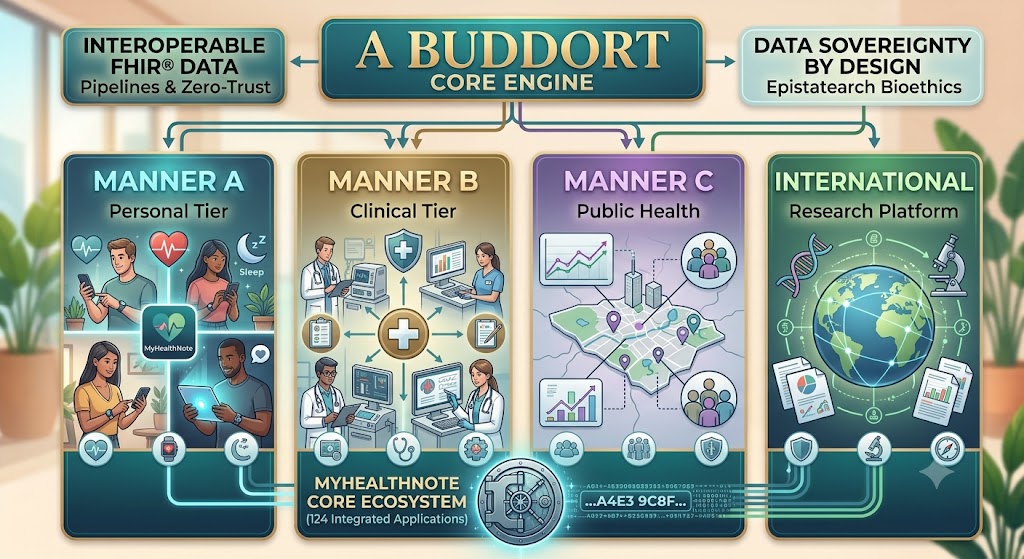
To solve this systemic breakdown, Buddort Technologies Co. engineered the foundation of the MyHealthNote Ecosystem—a unified digital health network consisting of 124 integrated applications operating seamlessly across four strategic operational tiers.
By unifying direct patient engagement, clinical hospital workflows, diagnostic IoT hardware, and user-held cryptographic verification, MyHealthNote transforms healthcare from passive, reactive record-keeping into active, predictive health stewardship.
Understanding the Four Strategic Tiers
The strength of the MyHealthNote platform lies in its multi-tiered architecture, designed to connect every stakeholder in the healthcare continuum without creating data silos or compromising privacy.
1. Manner A: Personal & Family Health (Direct-to-Subscriber)
- Who it’s for: Individuals, families, and community members.
- Core Capabilities: Mobile-first applications that allow subscribers to log personal metrics, track longitudinal health trends, join moderated community cohorts (Buddorts), and execute legally binding digital Advance Directives directly within their MyHealthCard.
- Data Sovereignty: Users hold their own cryptographic keys. Health data is never mined or monetized; subscribers retain total control over who accesses their records.
2. Manner B: Institutional & Clinical Networks (Healthcare Providers)
- Who it’s for: Private clinics, diagnostic centers, hospitals, and medical practitioners.
- Core Capabilities: Enterprise clinical management tools featuring HL7® FHIR® interoperability, automated sick-note generation, diagnostic hardware integration (such as Platform 5), and seamless point-of-care patient record access.
- Digital Notarization (Section 0.9): Clinical outputs generated in Manner B can be routed directly through integrated legal portals (such as Lawcraft Attorneys) for automated digital notarization and verification.
3. Manner C: Public Health & Community Initiatives (Ministries & NGOs)
- Who it’s for: Public health ministries, non-governmental organizations (e.g., LESCOTA), and field health officers.
- Core Capabilities: Real-time epidemiological dashboards, community risk stratification models, and field-survey engines built to run on offline-first mobile databases in low-bandwidth or rural settings.
- Predictive Disease Surveillance: Aggregates anonymized, population-level health trends to help public health leaders detect disease outbreaks early and allocate medical resources efficiently.
4. International Research & Bioethics Platform
- Who it’s for: Academic researchers, clinical trial leads, and global research partners.
- Core Capabilities: Tools for designing decentralized observational studies, managing cohort survey feedback from opted-in Buddorttes, and publishing evidence-based findings.
- Independent NGO Governance: Overseen by Epistatearch Company Ltd., ensuring every research project complies with strict bioethical standards, local laws (such as the Tanzania Personal Data Protection Act), and user consent frameworks.
Cryptographic Data Sovereignty: The SHA-256 Trust Engine
At the heart of the MyHealthNote infrastructure is Buddort’s SHA-256 cryptographic signature engine.
Every medical report, diagnostic result, and official document issued across the 124 apps is stamped with an immutable cryptographic hash and an embedded verification QR code.
Why Dual-Layer Verification Matters:
- Payload Protection: Prevents document forgery or “payload swapping” (e.g., cropping a valid QR code onto a fictitious medical report).
- Instant Verification: Scanning the QR code links directly to a secure verification portal, matching the physical/digital document against the encrypted server hash.
- Legal Watermarking: Allows retained legal counsel and notary partners to verify and apply official digital notary stamps seamlessly on top of the cryptographic proof.
Moving Beyond Passive Record-Keeping
By connecting software engineering (Buddort), operational stewardship (BrunelBrown Ops), and bioethical governance (Epistatearch), the MyHealthNote Ecosystem provides a blueprint for the future of global digital health.
It bridges the gap between individual health tracking and systemic public health insights—proving that health data systems can be enterprise-grade, highly scalable, and deeply empowering for the individual user.
 Buddort Technologies Co.