
In modern global health, designing software for pristine data centers with continuous gigabit internet is easy. Building high-performance, resilient health systems that operate seamlessly in rural field clinics, low-bandwidth environments, and complex multi-institutional networks requires a fundamentally different engineering paradigm.
At Buddort Technologies Co., we build health infrastructure engineered for real-world realities.
By combining HL7® FHIR® standards, zero-trust cryptographic security, offline-first mobile databases, and edge AI engines, our platform delivers uninterrupted care delivery and data sovereignty—from urban hospital centers to remote community health outposts.
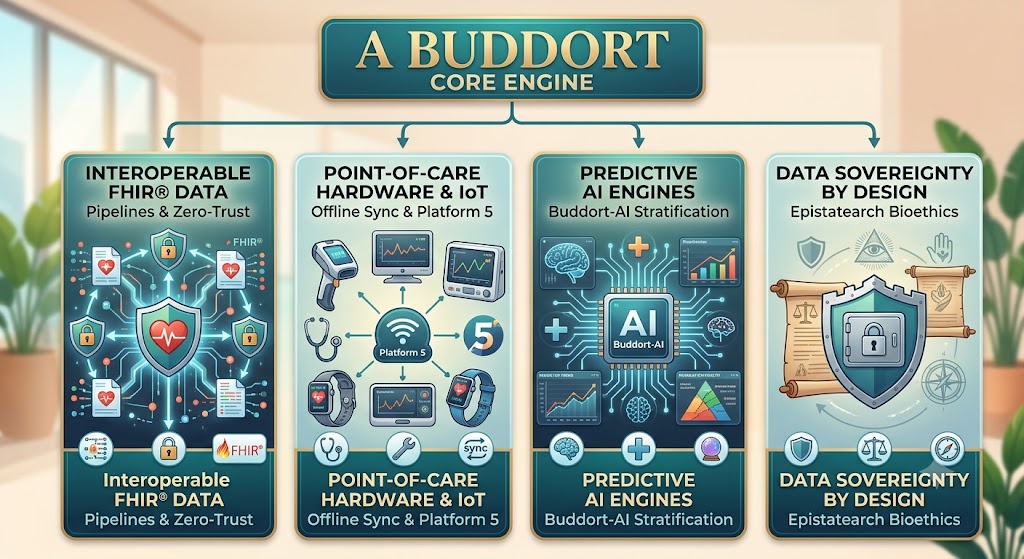
1. Interoperable Data Architectures (HL7® FHIR® & Zero-Trust)
Legacy electronic medical record (EMR) systems often operate in data silos, making cross-institutional care and longitudinal health tracking nearly impossible.
Buddort’s core architecture is built natively around HL7® FHIR® (Fast Healthcare Interoperability Resources) standards. This ensures that every clinical observation, diagnostic report, and patient demographic record can be exchanged frictionlessly across hospitals, private clinics, and public health databases without data loss or reformatting.
To protect sensitive health records across transit and storage, our pipelines enforce a Zero-Trust Security Framework:
- Cryptographic Signatures (SHA-256): Every generated report, sick note, or clinical summary receives an immutable hash seal to prevent tampering or document forgery.
- End-to-End Encryption: Data is encrypted at rest (AES-256) and in transit (TLS 1.3), ensuring strict confidentiality across open or untrusted networks.
2. Point-of-Care Hardware & IoT: Offline-First Deployment & Platform 5
Healthcare does not pause when cellular towers drop or internet connection fails.
Our systems feature an offline-first local database architecture. Field workers and clinicians can capture patient encounters, run diagnostic routines, and log longitudinal data without an active network connection. The platform queues transactions locally and executes differential synchronization as soon as connectivity is restored.
Deep Hardware & IoT Integration
Beyond software, Buddort integrates directly with diagnostic hardware and point-of-care IoT devices:
- Platform 5 Integration: Our software interfaces natively with specialized diagnostic hardware suites, such as Platform 5, allowing clinical parameters (vital signs, maternal indicators, diagnostic scans) to stream directly into the digital health record without manual data entry errors.
- Low-Power Edge Sync: Optimized for low-footprint mobile devices, ensuring high battery efficiency and speed even on low-spec hardware in low-resource environments.
3. Predictive AI Engines: Clinical Intelligence with Buddort-AI
Access to data is only half the battle; frontline healthcare workers need actionable, point-of-care intelligence to make rapid, life-saving decisions.
Our proprietary clinical decision engine, Buddort-AI, brings predictive risk stratification directly to health personnel at the point of care:
- Maternal & Public Health Risk Stratification: Buddort-AI analyzes localized clinical indicators in real time, automatically flagging high-risk patient profiles (such as pre-eclampsia risk factors or chronic disease escalations) for immediate clinical referral.
- Evidence-Based Decision Support: Powered by localized health research data and clinical protocols, the engine assists health workers with evidence-based next steps, reducing diagnostic turnaround times and improving patient outcomes in understaffed facilities.
4. Data Sovereignty by Design & Independent Bioethical Oversight
Technology must never compromise human rights or health data privacy.
Buddort’s architecture is engineered around the principle of True Data Sovereignty—ensuring that individuals and local health systems retain total ownership and control over their medical data in compliance with local regulations, including the Tanzania Personal Data Protection Act (PDPA).
Independent Oversight by Epistatearch
To guarantee that commercial or technical expansion never breaches ethical standards, the entire software and data architecture operates under the independent governance of Epistatearch Company Ltd.
As an independent non-governmental organization (NGO), Epistatearch conducts continuous bioethical audits across all operational tiers (Manner A, B, and C). This ensures that predictive algorithms remain unbiased, patient consent is strictly enforced, and health data is never commercialized without explicit user authorization.
Building the Future of Connected Health
By bridging robust hardware engineering, interoperable software pipelines, and independent bioethical governance, Buddort Technologies Co. is proving that enterprise healthcare technology can be both technologically advanced and deeply rooted in community needs.
Whether deploying national public health dashboards, powering clinical AI decision-making, or connecting remote rural health centers, our infrastructure is built to scale reliably, ethically, and continuously.
 Buddort Technologies Co.